
Emergency Laparotomy & Abdominal Trauma Surgery in Varanasi: 24/7 Acute Surgical Care
- emergency laparotomy surgery
- Blog
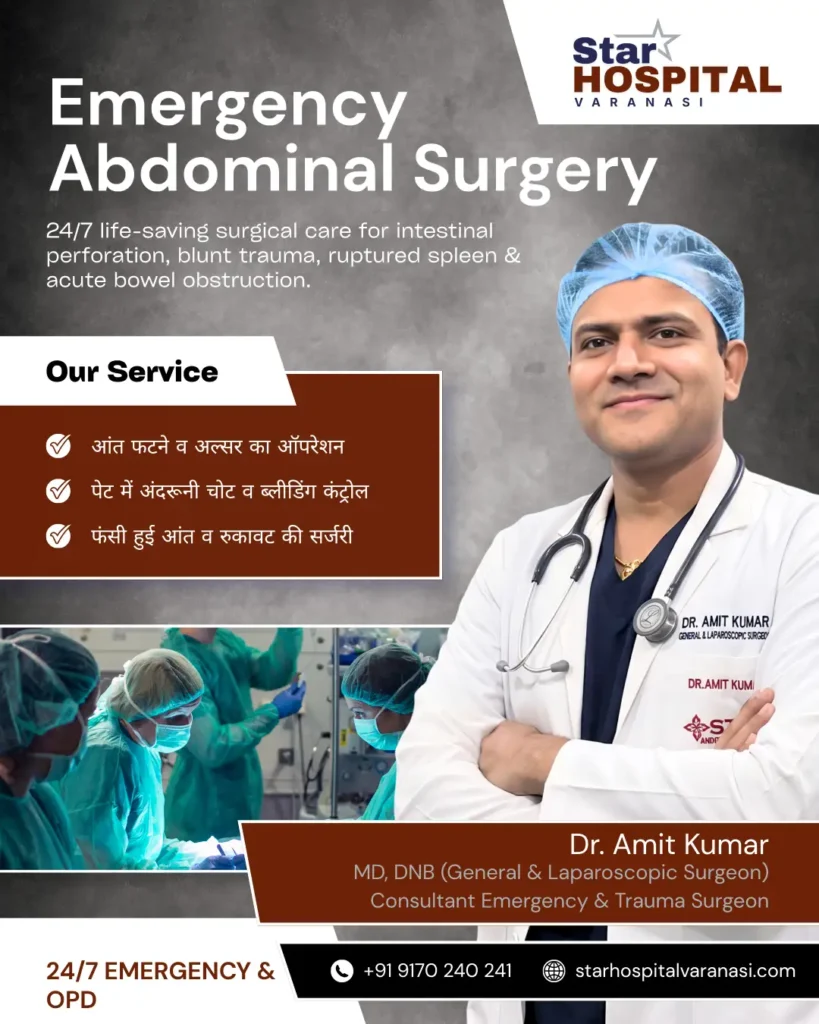
Emergency laparotomy surgery in Varanasi is a critical, life-saving open abdominal operation performed to rapidly stop internal hemorrhage, close gastrointestinal perforations (ruptured bowel), drain widespread abdominal sepsis (peritonitis), and release strangulated bowel obstructions. At Star Hospital Varanasi (located at Akhari Bypass, Chitaipur), emergency abdominal surgical interventions are led 24/7 by Dr. Amit Kumar (MD, DNB General & Laparoscopic Surgeon). Supported by Class-100 modular operating theatres and a dedicated Level-3 Intensive Care Unit (ICU), the hospital handles road accident abdominal trauma, liver/spleen lacerations, and burst peptic ulcers with 100% cashless treatment under Ayushman Bharat (PM-JAY). For immediate casualty admission or emergency surgeon consultation, call +91 9170 240 241.
Sudden, unbearable abdominal pain, a rigid board-like stomach, intractable vomiting, or blunt trauma sustained during a motor vehicle collision along the national bypass are signs of an acute surgical abdomen. In these life-threatening clinical moments, routine diagnostic delays or medical management alone can prove catastrophic. Bacterial contamination of the peritoneal cavity leads to septic shock, hemodynamic collapse, and multi-organ failure within hours.
Navigating an abdominal emergency requires an experienced abdominal trauma surgeon in Varanasi backed by an institutional setup capable of immediate surgical exploration. Under the clinical leadership of Dr. Amit Kumar, the Department of Emergency & General Surgery at Star Hospital delivers round-the-clock surgical care for complex intestinal perforations, traumatic internal organ damage, and acute strangulated bowel loops, serving patients across Varanasi, Chunar, Mirzapur, Sonbhadra, and adjoining districts.
What is an Emergency Exploratory Laparotomy?
An exploratory laparotomy is a surgical intervention where a vertical midline incision is made through the abdominal wall to access, inspect, and treat pathology within the peritoneal cavity. While elective abdominal procedures are often conducted laparoscopically (via keyhole methods), acute trauma and widespread abdominal contamination mandate an immediate open laparotomy to gain rapid control over life-threatening conditions.
Acute Abdominal Emergency
(Severe Trauma / Perforation / Obstruction)
│
▼
Emergency Triage & Fluid Resuscitation
(Star Hospital 24/7 Casualty Desk)
│
▼
Urgent Diagnostics: FAST Ultrasound & CECT Scan
│
▼
Immediate Transfer to Class-100 Modular OT Suite
│
▼
Emergency Exploratory Laparotomy
• Hemostasis (Control Internal Bleeding)
• Closure of Perforation / Resection
• Extensive Warm Saline Peritoneal Lavage
│
▼
Level-3 ICU Critical Care & Hemodynamic Monitoring
When is an Emergency Laparotomy Required?
Dr. Amit Kumar performs emergency exploratory laparotomy for multiple life-threatening indications:
Pneumoperitoneum: Free air visible beneath the diaphragm on a chest/abdominal X-ray, confirming a hollow organ (stomach or intestine) has ruptured.
Generalized Peritonitis: Widespread bacterial infection of the abdominal lining characterized by involuntary abdominal rigidity, high fever, and extreme tenderness.
Hemoperitoneum: Massive internal blood accumulation in the belly following blunt or penetrating trauma.
Intestinal Gangrene: Dead bowel tissue secondary to twisted intestines (volvulus) or strangulated abdominal hernias.
Evisceration or Penetrating Wounds: Stab, projectile, or impalement trauma penetrating the deep fascia of the abdomen.
Intestinal Perforation Surgery in Varanasi: Closing the Leaks
Gastrointestinal (GI) perforation occurs when a pathology burns through or tears the wall of the stomach, duodenum, small intestine, or colon. Once breached, caustic gastric juices, bile, digestive enzymes, and fecal bacteria spill directly into the sterile abdominal cavity.
Common Causes of GI Perforation:
- Perforated Peptic Ulcer: Chronic gastric or duodenal ulcers that erode completely through the organ wall, common in individuals with long-term NSAID (painkiller) use or untreated H. pylori infections.
- Typhoid Enteric Perforation: A dangerous complication of severe Salmonella typhi infection, causing necrosis and longitudinal perforations along the terminal ileum.
- Traumatic Bowel Rupture: Sudden compression or steering wheel impact rupturing fluid-filled intestinal loops.
- Malignant or Diverticular Perforations: Colonic ruptures caused by advanced obstructing tumors or acute diverticulitis.
Surgical Precision with Dr. Amit Kumar
During intestinal perforation surgery in Varanasi, Dr. Amit Kumar conducts systematic surgical decontamination:
- Graham’s Omental Patching: For duodenal ulcer perforations, the defect is closed with non-absorbable sutures and reinforced with a live pedicled flap of healthy omental fat tissue.
- Bowel Resection and Primary Anastomosis: Severely damaged, devitalized, or necrotic bowel segments are cleanly resected, and the healthy ends are reconnected using hand-sewn or surgical stapling techniques.
- Temporary Stoma Creation (Ileostomy/Colostomy): In cases with severe fecal contamination, gross peritoneal sepsis, or unstable vital signs, exteriorizing the bowel protects the patient from anastomotic leak, allowing the abdomen to heal safely before reversal.
- Copious Peritoneal Lavage: Washing the abdominal cavity with liters of warm normal saline to remove toxins, fibrinous exudate, and purulent fluid.


Blunt & Penetrating Abdominal Trauma: Splenic Rupture & Liver Lacerations
Road traffic collisions along high-speed corridors like the Varanasi–Chunar highway represent the leading cause of blunt abdominal trauma. The sudden deceleration force crushes solid parenchymal organs against the spinal column or lower ribs.
--------------------------------------------------------------------------------+
| DAMAGE CONTROL SURGERY (DCS) TIMELINE |
+--------------------------------------------------------------------------------+
| STAGE 1: Operating Room (Minutes 0 - 60) |
| • Rapid Midline Laparotomy |
| • Pack all 4 Abdominal Quadrants to arrest catastrophic hemorrhage |
| • Control enteric contamination (staple or tie off bowel tears) |
| • Temporary abdominal closure (Bogota bag or negative-pressure wound therapy) |
+--------------------------------------------------------------------------------+
| STAGE 2: Level-3 Critical Care ICU (Hours 1 - 24) |
| • Aggressive correction of the "Lethal Triad": Hypothermia, Acidosis, |
| and Coagulopathy |
| • Invasive arterial blood pressure monitoring and massive transfusion protocols|
+--------------------------------------------------------------------------------+
| STAGE 3: Planned Re-Exploration in OT (Hours 24 - 48) |
| • Removal of surgical packs |
| • Definitive organ repair, resection, or vascular reconstruction |
| • Formal abdominal wall closure |
+--------------------------------------------------------------------------------+
1. Splenic Rupture & Emergency Splenectomy
The spleen is the most frequently injured organ in blunt abdominal impacts. Because it is highly vascular, a shattered spleen causes rapid intraperitoneal hemorrhage, manifesting as dizziness, left upper quadrant pain, pain radiating to the left shoulder (Kehr’s sign), and profound hypotension.
Grade I-III Injuries: In hemodynamically stable patients, conservative management with continuous ICU hemodynamic monitoring is attempted.
Grade IV-V Shattered Spleen: If the patient remains unstable or displays contrast extravasation, Dr. Amit Kumar performs an emergency splenectomy (complete surgical removal of the spleen) to arrest fatal bleeding immediately.
2. Liver Lacerations & Hepatic Trauma
As the largest solid internal organ, liver trauma requires rapid surgical packing, topical hemostatic agents, Pringle’s maneuver (temporary occlusion of the hepatoduodenal ligament to control hepatic inflow), and precision suture hepatorrhaphy to arrest persistent bleeding.
Acute Intestinal Obstruction, Strangulated Hernia & Volvulus Relief
Mechanical bowel obstruction prevents food, digestive fluids, and gas from traversing the intestines. Untreated, intraluminal pressure mounts rapidly, compromising arterial blood flow and inducing bowel gangrene and systemic perforation.
Surgical Interventions Performed:
Adhesiolysis for Post-Operative Bands: Precision division of fibrous scar bands from previous surgeries that snare and strangle bowel loops.
Sigmoid & Cecal Volvulus Derotation: Emergency detorsion of twisted colonic loops, followed by resection and primary anastomosis (or Hartmann’s procedure) to eliminate recurrence.
Strangulated Hernia Repair: Prompt surgical release of trapped, dying bowel loops trapped within an inguinal, femoral, or incisional hernia defect, followed by anatomical tissue and mesh repair.
Intussusception Resection: Managing telescoping bowel segments in young adults and elderly patients often harboring underlying polyps or tumors.
Institutional Comparison: Emergency Abdominal Surgery in Varanasi
| Critical Parameters | Basic Nursing Home / Day-Care Clinic | Emergency Trauma Surgical Unit at Star Hospital |
| Operating Surgeon | Visiting / On-Call General Practitioner | Dr. Amit Kumar (MD, DNB General & Laparoscopic Surgeon) |
| Diagnostic Turnaround | Outsource to external labs (Delays) | 24/7 Point-of-Care ABG, Rapid Blood Bank & High-Speed CT |
| Surgical Operating Suites | Basic Non-Laminar OT | Class-100 Modular OT with Continuous Laminar Airflow |
| Critical Care Back-Up | Shared single ward / No intensivist | 24/7 Level-3 Dedicated ICU with Intensivists (Dr. S.S. Behera) |
| Damage Control Surgery | Not equipped for severe polytrauma | Protocolized Multi-Stage Damage Control Surgical Pathways |
| Government Schemes | Out-of-Pocket Cash Billing | 100% Cashless Ayushman Bharat (PM-JAY) for eligible cases |
Advanced Surgical & Critical Care Infrastructure at Star Hospital Varanasi
Successful recovery from an emergency exploratory laparotomy depends on perioperative infrastructure and post-operative intensive care support:
Class-100 Modular Operating Theatres: Equipped with laminar air flow, HEPA filtration, modern electrosurgical units, advanced harmonic scalpels, and rapid blood warmers to safeguard against intraoperative hypothermia and surgical site infections.
Dedicated Level-3 Intensive Care Unit (ICU): Directed by senior critical care intensivists led by Dr. S.S. Behera (DM Critical Care Specialist, AIIMS & NIMHANS trained). Patients emerging from septic shock receive advanced invasive arterial line monitoring, mechanical ventilation, and bedside continuous renal replacement therapy (CRRT) when acute kidney injury coexists.
On-Site Emergency Blood Bank Coordination: Immediate access to packed red blood cells (PRBCs), fresh frozen plasma (FFP), and platelets for life-saving massive transfusion protocols.
Multispecialty Surgical Integration: Seamless cross-specialty support with Dr. Abhishek Das (Maxillofacial Surgery) and Dr. Gautam Prakash (Plastic Surgery) for polytrauma victims presenting with concurrent head, facial, and limb fractures.
Ayushman Bharat (PM-JAY) & Cashless Emergency Surgical Care
An unexpected road accident or emergency surgical complication should not burden families with debt. Star Hospital Varanasi is an empaneled private hospital under the Ayushman Bharat (PM-JAY) scheme.
100% Cashless Emergency Admission: Eligible Ayushman Card holders receive end-to-end cashless care covering emergency exploratory laparotomy, bowel resection, surgical staplers, trauma consumables, Level-3 ICU bed charges, and post-operative recovery medications.
Corporate Insurance & TPAs: Dedicated 24/7 insurance desk facilitating instant cashless approval through all major health insurance providers (Star Health, HDFC ERGO, ICICI Lombard, Care Health, Medi Assist, Vidal, etc.).
Transparent Hospital Billing: Direct, clearly explained treatment cost estimates for non-insured private patients with no hidden surgical or theater costs.
Strategic Highway Proximity: Fast-Track Trauma Admissions at Akhari Bypass
Time lost during inner-city traffic transit can alter patient outcomes in severe internal abdominal bleeding. Star Hospital is situated at Akhari Bypass (Chunar Road Underpass), Chitaipur, Varanasi.
Direct Highway Connectivity: Patients transported from Mirzapur, Chunar, Robertsganj, Sonbhadra, and NH-19 reach our casualty doors directly without navigating inner-city gridlocks.
Quick Access for Varanasi Suburbs: Minutes away from Lanka, DLW (BLW), Susuwahi, Sundarpur, and BHU Trauma Center corridors.
Zero-Delay Emergency Casualty Gate: Immediate triage assessment by medical officers, fast-track abdominal ultrasound (FAST), and direct transfer to the modular OT within minutes of arrival[cite: 8].
Frequently Asked Questions (FAQs
Dr. Amit Kumar (MD, DNB General and Laparoscopic Surgeon) at Star Hospital Varanasi is a leading specialist in acute abdominal surgery. He provides 24/7 care for perforated ulcers, burst intestines, severe abdominal trauma, and acute intestinal blockages.
आंत में छेद होने या अल्सर फटने पर पेट में गंभीर संक्रमण (पेरिटोनिटिस) फैल जाता है। स्टार हॉस्पिटल में सर्जन डॉ. अमित कुमार इमरजेंसी लेप्रोटोमी (ओपन सर्जरी) द्वारा छेद को बंद करते हैं, संक्रमित तरल को बाहर निकालते हैं और आंतों की धुलाई (पेरिटोनियल लवाज) करते हैं। गंभीर स्थिति में कुछ समय के लिए अस्थाई मल का रास्ता (स्टोमा/इलियोस्टॉमी) बनाया जाता है।
Signs of internal abdominal bleeding (such as a ruptured spleen or liver tear) include severe abdominal pain, a hard or swollen belly, dizziness, fainting, cold or clammy extremities, rapid pulse, and pain radiating to the left shoulder tip (Kehr’s sign). Immediate medical evaluation is vital.
आंतों में रुकावट (Intestinal Obstruction) होने पर मरीज को तेज पेट दर्द, उल्टी, पेट फूलना और गैस/मल का पास न होना जैसे लक्षण होते हैं। यदि दवाइयों से रुकावट नहीं खुलती, तो डॉ. अमित कुमार द्वारा इमरजेंसी सर्जरी करके फंसी हुई आंत को खोला जाता है और सड़ी हुई आंत को काटकर स्वस्थ हिस्सों को दोबारा जोड़ दिया जाता है।
Yes, emergency laparotomy, intestinal perforation repair, and traumatic organ removal surgeries are 100% cashless for eligible beneficiaries carrying a valid Ayushman Bharat (PM-JAY) card at Star Hospital Varanasi.
Consult Dr. Amit Kumar – 24/7 Emergency Surgery Unit
Do not ignore acute, unremitting abdominal pain, signs of peritonitis, or internal injury sustained in a motor vehicle accident. Immediate surgical evaluation can protect lives and prevent severe systemic sepsis.
Hospital: Star Hospital Varanasi
Department: General, Laparoscopic & Emergency Trauma Surgery
Lead Specialist: Dr. Amit Kumar (MD, DNB General Surgeon)
Address: Akhari Bypass (Chunar Road Underpass), Chitaipur, Varanasi, Uttar Pradesh 221005
24/7 Emergency & ICU Helpline: +91 9170 240 241[cite: 4]
Official Website: www.starhospitalvaranasi.com[cite: 4]
Star hospital Varanasi location
NMC Medical Disclaimer & Compliance:
This clinical educational article is published strictly for public health education, emergency awareness, and informational transparency. It does not establish a formal physician-patient relationship or replace individualized medical assessment. Procedural necessity, operative choice (open vs. minimally invasive), and recovery outcomes depend on individual radiological diagnostics (CECT/FAST ultrasound), hemodynamic stability, and physical evaluation. Star Hospital adheres to the ethical clinical guidelines mandated by the National Medical Commission (NMC). In the event of acute abdominal pain, suspected intestinal rupture, or trauma, contact our 24/7 emergency casualty desk at +91 9170 240 241 or report directly to the emergency department[cite: 4].
आपातकालीन स्थिति? तुरंत स्टार हॉस्पिटल वाराणसी से संपर्क करें
Don't wait in an emergency. Star Hospital Varanasi offers 24/7 life-support ambulances, advanced ICU/NICU care, and 100% Free Cashless Treatment (up to ₹5 Lakh) via Ayushman Card & Vidhayak Nidhi under Kashi’s finest AIIMS-level super-specialists.
Health Alerts & Insights
Stay updated with essential medical advice, health tips, and free camp announcements directly from Kashi’s top specialists at Star Hospital Varanasi.
24/7 Emergency Support
Every second matters in a medical crisis. Contact our rapid response trauma team right away for immediate ambulance dispatch.
Categories
- Uncategories
- Health Tips
- About Us

Kashi’s trusted multispeciality hospital offering 24/7 emergency trauma, advanced ICU/NICU, and premier clinical care near Chitaipur
Navigation
- Home
- Pages
- About Us
- Services
Quick Link
- Contact Us
- FAQs
- Booking
- Pages
Services
- Home
- Contact
- Blog
- 404
© 2026 Star Hopital Varanasi • All Rights Reserved – Devloped & maintain by Nexus DigiTech