
Microvascular Reconstructive Surgery & Facial Trauma Care at Star Hospital Varanasi
- Healthcare
- Blog
Introduction: Best Facial Trauma Care at Star Hospital Varanasi Dr. Abhishek Das
Surgical removal of head and neck tumors or severe impact injuries from road traffic accidents can leave substantial structural deficits in the jaw, tongue, and facial bones. In eastern Uttar Pradesh, patients requiring complex reconstructive surgery often face the dilemma of traveling outside the Purvanchal region to metro centers.
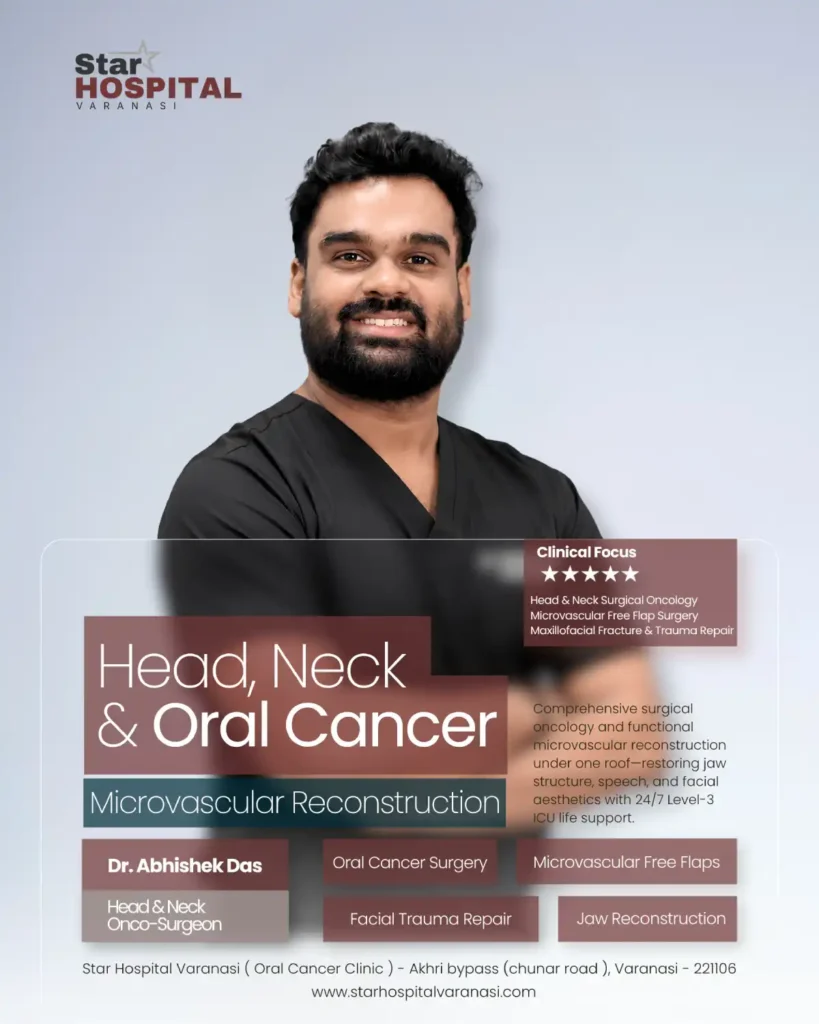
Advanced surgical intervention can safely preserve both form and vital function. Dr. Abhishek Das brings specialized expertise in head and neck surgical oncology, maxillofacial trauma, and microvascular free flap surgery to Star Hospital Varanasi. Through sophisticated microsurgical tissue transfer, patients dealing with severe facial trauma, post-excisional oral cancer defects, and complex reconstructive challenges receive coordinated, tertiary-level clinical care in Varanasi.
What Is Microvascular Free Flap Reconstructive Surgery?
Microvascular free flap surgery is an advanced reconstructive technique where living tissue (skin, muscle, bone, or fat) is harvested from a healthy donor site on the patient’s body and transplanted to repair a severe structural defect, with its blood vessels meticulously reconnected under an operating microscope.
+——————+ Transplantation under +——————-+
| Donor Site | —> Operating Microscope —> | Recipient Defect |
| (Fibula / Thigh) | (Arteries & Veins) | (Jaw / Tongue) |
+——————+ +——————-+
Unlike traditional rotational flaps, which remain attached to their original blood supply, a free flap involves:
Complete detachment of donor tissue along with its feeding artery and draining vein.
Transfer of the tissue to the recipient site (such as the mandible, maxilla, oral cavity, or face).
Microsurgical vascular anastomosis—joining vessels measuring only 1 to 3 millimeters in diameter using ultra-fine sutures.
This immediate restoration of blood flow prevents tissue necrosis and allows surgeons to reconstruct massive three-dimensional jaw and soft-tissue defects following cancer surgery or severe trauma.
When Is Microvascular & Reconstructive Surgery Required?
Patients in Varanasi and neighboring districts seek consultation for microvascular reconstructive surgery and facial reconstruction across several clinical conditions:
Post-Oral Cancer Resection Deficits: Radical resections such as mandibulectomies (removal of lower jaw bone), maxillectomies (upper jaw resection), or composite glossectomies (tongue resections) leave significant voids that require immediate vascularized bone or soft-tissue reconstruction to preserve swallowing, speech, and airway integrity.
Severe Maxillofacial and Facial Trauma: High-velocity vehicular collisions along arterial highways (such as the NH-19 and Chunar Road corridors) frequently cause comminuted mandibular fractures, midface pan-facial injuries, and extensive soft-tissue avulsions requiring microvascular reconstruction.
Post-Burn Contractures & Deformities: Scar contractures of the neck, face, and extremities that severely restrict range of motion and alter anatomy.
Complex Hand Injuries & Tendon Lacerations: Industrial and accidental injuries requiring tendon reconstruction, microvascular nerve repair, and coverage using local or distant flaps.
Osteoradionecrosis (ORN): Radiation-induced bone necrosis of the jaw following oncology treatments, requiring non-vascularized bone replacement with healthy, vascularized free tissue (such as a free fibula flap).
Types of Free Flaps Used in Head, Neck, and Trauma Reconstruction
Depending on whether bone, soft tissue, or composite coverage is required, reconstructive surgeons select specific donor tissues:
| Flap Type | Primary Donor Site | Tissue Components | Best Suited Clinical Applications |
| Free Fibula Flap (FFF) | Lower Leg (Fibula Bone) | Vascularized bone, muscle, skin island | Mandible (jaw) reconstruction, composite jaw and skin defect repair |
| Anterolateral Thigh Flap (ALT) | Upper Thigh | Skin, subcutaneous fat, fascia | Tongue, cheek, oral mucosa, and extensive scalp defect coverage |
| Radial Forearm Free Flap (RFFF) | Inner Forearm | Pliable thin skin, fascia | Delicate oral reconstruction (floor of mouth, soft palate, tongue mobility) |
| Latissimus Dorsi Flap (LD) | Upper Back | Broad muscle, skin paddle | Massive soft-tissue defects, extensive scalp loss, major trauma coverage |
The Surgical Procedure: Step-by-Step Clinical Approach
Microvascular reconstruction requires a synchronized, multidisciplinary approach executed in specialized modular operation theaters:
Phase 1: Pre-Operative Virtual Planning & Diagnostics
High-resolution 3D CT angiography evaluates both the recipient defect and the vascular architecture of donor sites (such as lower extremity vessel patency). In complex jaw reconstruction, virtual surgical planning helps precisely calculate bone cutting angles (osteotomies) to mirror the patient’s natural facial symmetry.
Phase 2: Dual-Team Simultaneous Surgery
To reduce anesthesia duration, surgical workflows operate in tandem:
Ablative/Trauma Team: Clears the primary tumor with verified clear margins or debrides and stabilizes complex facial fractures.
Reconstructive Microsurgical Team: Harvests the designated vascularized donor flap (e.g., free fibula or ALT) along with its vascular pedicle.
Phase 3: Microsurgical Vascular Anastomosis
Under high-power operative magnification, the donor artery and vein are anastomosed to the facial artery and internal jugular/tributary veins. Once vascular clamps are released, tissue perfusion is directly confirmed via capillary refill and microvascular Doppler monitoring.
Phase 4: Dedicated Post-Operative ICU Care
Flap survival depends heavily on the first 72 hours post-surgery. Patients are monitored in a dedicated Level-3 ICU under controlled hemodynamic conditions directed by critical care teams (headed by Dr. S.S. Behera) to maintain stable blood pressure, oxygenation, and fluid balance, preventing vasospasm or micro-thrombosis.
Why Choose Reconstructive Surgery at Star Hospital, Varanasi?
Patients evaluating reconstructive and maxillofacial surgical options in Varanasi should assess concrete clinical capabilities:
Surgical Oncology & Microsurgical Synergy: Dr. Abhishek Das brings specialized training in head and neck surgical oncology and microvascular reconstruction (Tata Memorial Hospital fellowship background), enabling primary oncologic clearance and functional reconstruction to occur in a single surgical session.
Critical Care Backup (Level-3 ICU): Reconstructive free-flap cases require intensive post-operative resuscitation and airway surveillance. The ICU infrastructure at Star Hospital, led by AIIMS/BHU-trained intensivist Dr. S.S. Behera, provides continuous arterial monitoring and ventilator support.
24×7 Trauma & Accidental Stabilization: Located strategically at Akhari Bypass (Chunar Road), Star Hospital functions as an immediate trauma stabilization and surgical center for road accidents requiring facial fracture fixation and emergency coverage.
Comprehensive Cashless Healthcare Support: Treatments are accessible via major cashless health insurance networks (TPAs) and the Ayushman Bharat (PM-JAY) scheme, reducing financial stress for complex procedures.
Factors That Determine the Cost of Reconstructive Surgery in Varanasi
Rather than standardized flat rates, the financial requirements for reconstructive surgery depend on several clinical variables:
Complexity of the Defect: A localized soft-tissue flap involves different surgical requirements than a composite 3D jaw bone reconstruction using titanium reconstruction plates and microvascular anastomosis.
Operating Theater Duration: Microvascular free flap surgeries typically range from 6 to 10 hours and require specialized microsurgical instrument sets, vascular clamps, and micro-sutures.
Duration of ICU & Inpatient Stay: Post-operative flap surveillance requires 48 to 72 hours of intensive monitoring, followed by dedicated hospital ward recovery.
Hardware & Prosthetic Implants: Reconstructing bony structures requires patient-specific titanium plates, surgical screws, and reconstructive accessories.
Patients can request a transparent pre-surgical evaluation covering theater charges, ICU stay, and cashless insurance pre-authorization at the hospital helpdesk.
Post-Surgical Recovery and Functional Rehabilitation
Functional recovery after head, neck, and microvascular surgery progresses through planned stages:
[Days 1–3: ICU Monitoring] –> [Days 4–7: Ward Mobility] –> [Weeks 2–4: Discharge & Therapy] –> [Months 2–6: Functional Restoration]
Vital perfusion checks; Gentle mobilization; Suture removal; initial speech Full jaw consolidation;
hemodynamic support. swallowing re-training. and swallowing exercises. dental implant rehabilitation.
Days 1 to 3 (Flap Monitoring Phase): Continuous checks of skin paddle color, warmth, pinprick bleeding, and handheld Doppler signals.
Days 4 to 7 (Mobility & Tube Feeding): Transition from parenteral fluids to enteral/Ryle’s tube nutrition; progressive ambulation.
Weeks 2 to 4 (Wound Healing & Therapy): Removal of donor-site sutures; structured evaluation with speech and swallowing therapists.
Months 2 to 6 (Long-Term Rehabilitation): Bone remodeling (in free fibula cases) and secondary procedures, such as endosseous dental implants, to restore complete chewing ability.
Frequently Asked Questions
Dr. Abhishek Das specializes in oral oncologic surgery, maxillofacial trauma management, and microvascular reconstructive procedures. He focuses on radical excision of head and neck pathologies combined with functional and aesthetic reconstruction using advanced tissue flap techniques.
Internationally documented success rates for microvascular free flaps in high-volume tertiary centers range between 92% and 96%. Success depends heavily on early surgical intervention, microvascular technique, patient non-smoking status, and strict post-operative ICU monitoring during the critical first 72 hours.
Varanasi mein complete microvascular surgery ke liye aisa center chunein jahan experienced onco-reconstructive surgeon ke sath 24x7 Level-3 ICU, advanced modular OT, aur trained critical care team uplabdh ho. Star Hospital (Akhari Bypass, Chunar Road) yeh comprehensive surgical aur ICU infrastructure ek hi chhat ke niche pradan karta hai.
Most patients require a hospital stay of 7 to 12 days. This typically includes 2 to 3 days in the Level-3 ICU for microvascular flap surveillance, followed by 5 to 8 days in the surgical ward for wound care, speech therapy, and nutritional rehabilitation.
Haan, Star Hospital Ayushman Bharat (PM-JAY) yojana ke antargat empanelled hai. Eligible surgical oncology, accidental trauma, aur reconstructive procedures sarkari dishanirdeshon ke anusar cashless suvidha ke tehat cover kiye jaate hain.
Yes. Modern microvascular free flap surgery reconstructs both the skeletal framework (using vascularized bone like the fibula) and outer soft tissues. This approach prevents facial collapse, maintains speech articulation, preserves the airway, and supports functional dental rehabilitation.
While general plastic surgery encompasses both aesthetic improvements and basic wound management, microvascular reconstructive surgery is a subspecialty focused on transferring living tissue with its micro-arteries and veins to repair massive defects from cancer or severe trauma under an operating microscope.
Far far away, behind the word mountains, far from the countries Vokalia and Consonantia, there live the blind texts. Separated they live in Bookmarksgrove right at the coast
Road accidents ke baad facial bone fractures aur soft-tissue lacerations ka ilaaj patient ke hemodynamically stable hote hi 24 se 72 ghante ke bheetar shuru kiya jana chahiye. Isse irreversible scarring, facial deformity, aur improper bone healing (malunion) se bacha ja sakta hai.
Total Insurance and Government Scheme Support
To ensure quality healthcare remains highly affordable, Star Hospital features a fully integrated cashless insurance department:
Cashless TPA Panels: Smooth tie-ups with all major health insurance providers.
Ayushman Bharat (PM-JAY): Proudly extending full treatment capabilities to Ayushman Cardholders under prescribed government healthcare initiatives.
Star hospital Varanasi location
Star Hospital Akhari Bypass Varanasi Contact Number
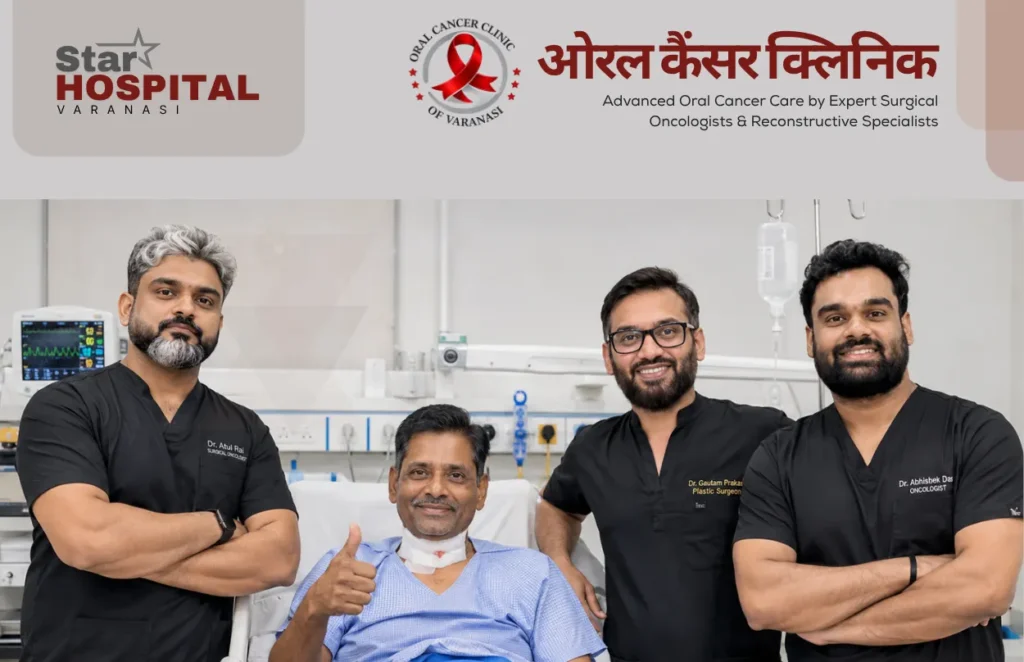
To schedule an oncology evaluation, biopsy review, or second opinion with Dr. Atul Kumar Rai, Dr. Abhishek Das, or Dr. Gautam Prakash:
Hospital: Star Multispeciality Hospital
Departments: Surgical Oncology & Reconstructive Plastic Surgery
Specialist Panel:
Dr. Atul Kumar Rai | Head & Neck Cancer Surgeon
Dr. Abhishek Das | Surgical Oncologist & Oral Cancer Surgeon
Dr. Gautam Prakash | MBBS, MS (BHU), MCh Plastic Surgery (IMS-BHU)
Address: Star Hospital, Akhari Bypass (Chunar Road), Bari Bazar, Amara, Varanasi, UP – 221106
24/7 Helpline & Appointments: +91 9151-0999-71 | +91 9151-0999-72
Official Websites: starhospitalvaranasi.com | [suspicious link removed]
🏥 Guidelines for Attending Family Members & Patients
Registration Process: Kindly bring your unique UHID card or past OPD slips upon every consecutive visit.
Documentation Support: Always carry all historic diagnostic records, X-Ray sheets, and ongoing medical prescriptions to facilitate precise analysis by our consultants.
Strict Premises Protocols: Star Hospital maintaining a zero-tolerance policy against tobacco consumption and smoking inside the clinical perimeters to uphold supreme air sterility.
आपातकालीन स्थिति? तुरंत स्टार हॉस्पिटल वाराणसी से संपर्क करें
Dr Gautam Prakash expertise
Health Alerts & Insights
Stay updated with essential medical advice, health tips, and free camp announcements directly from Kashi’s top specialists at Star Hospital Varanasi.
24/7 Emergency Support
Every second matters in a medical crisis. Contact our rapid response trauma team right away for immediate ambulance dispatch.
Categories
- About Us
- Oral Cancer
Kashi’s trusted multispeciality hospital offering 24/7 emergency trauma, advanced ICU/NICU, and premier clinical care near Chitaipur
Navigation
- Home
- Pages
- About Us
- Services
Quick Link
- Contact Us
- FAQs
- Booking
- Pages
Services
- Home
- Contact
- Blog
- 404
© 2026 Star Hopital Varanasi • All Rights Reserved – Devloped & maintain by Nexus DigiTech